
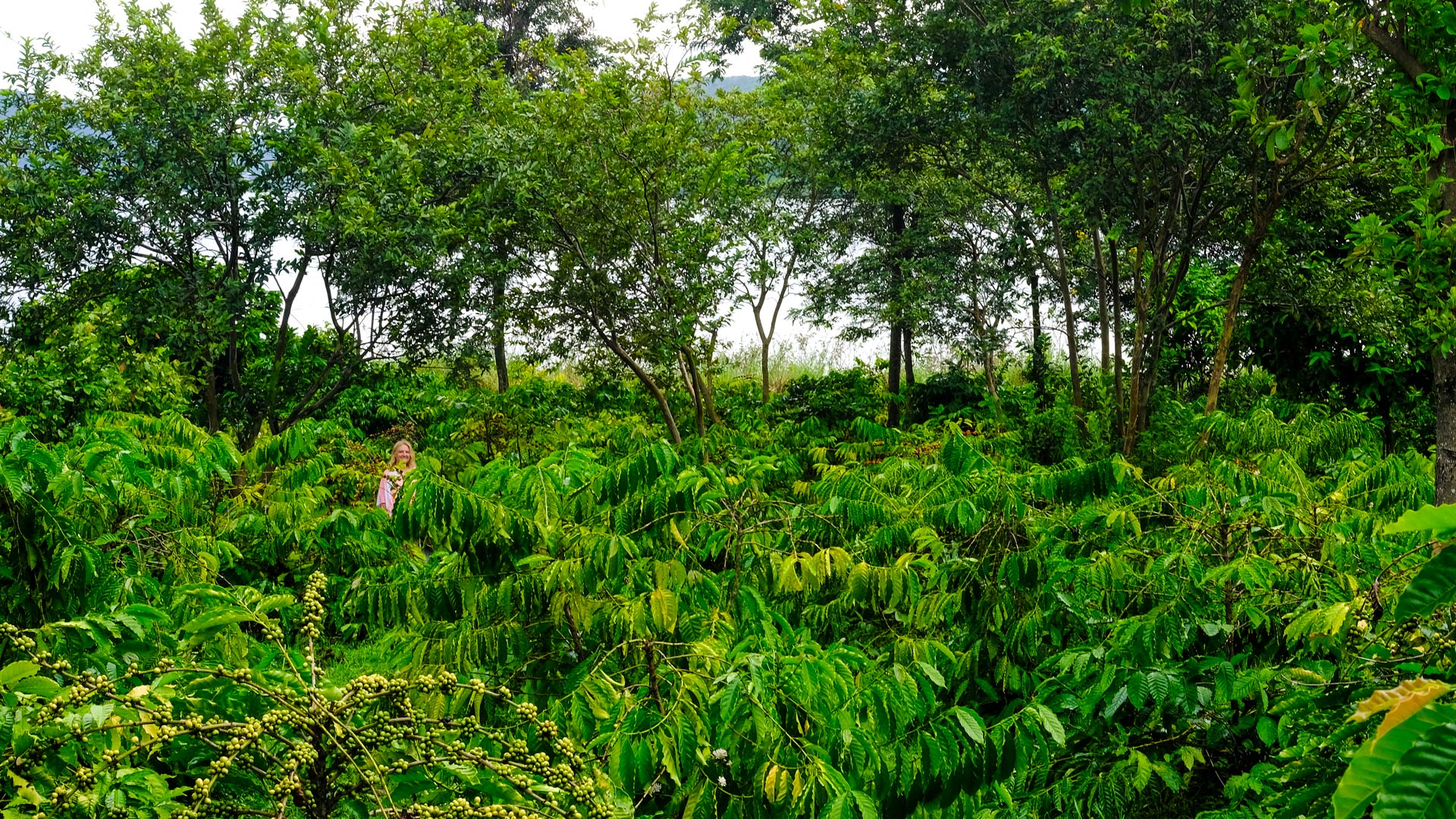
We followed a trail of butterflies off the end of a garden in Vietnam’s Central Highlands and walked into a farm we could not read.
The first plants carried heavy pods. Alice thought fruit of some kind. They were cacao. Further along there were bushes hung with bright red cherries, too glossy to look real, and it was hours before anyone told us that was coffee. The third crop we managed between us. Avocados.

Three things we ate or drank most days of our lives, growing within a short walk of each other, and between us we could name one.
This was 2022. We had come to Vietnam to see our son, and we were in the Central Highlands because someone had mentioned in passing that it was where the coffee came from. We were more interested in the pho. The next morning the owner of the guesthouse mentioned that his cousin farmed nearby, and asked whether we would like to see a proper farm.
What a coffee farm turned out to look like
It ran across several terraced hillsides, and what struck us was not the size of it but how crowded it was.
We had a picture in our heads of what a coffee farm looked like, though neither of us could have said where the picture came from. Rows. One green crop going over a hill. What we walked into was nothing like that. There was coffee everywhere, and there was a great deal else growing with it. Taller trees standing over the coffee. Beans. Fruit. Things at ankle height that we did not recognise and did not think to ask about. It looked less like a field than like a wood that happened to be productive.
He walked us through it and told us what was doing what. The tall trees were there to shade the coffee. The beans fed the soil, so that less had to be bought and carried in. The fruit trees brought the birds, and the birds dealt with a good deal of what would otherwise have to be sprayed. None of it was decorative. Every one of those plants was working, and he could tell you its job.
It was more work to understand than a single crop, he said. But once you had learned it, it worked better.
Then he told us the thing that has stayed with us longest, and it had nothing to do with soil. When the coffee price fell, the family still had avocado, banana and vegetables.
That is the part that does not photograph. One crop pays once a year, and it pays whatever the market says it pays. A mixed plot pays smaller amounts, in different months, in food as well as in cash, and it carries on paying when the single number everybody else is watching has gone the wrong way. It is not a picturesque way to farm. It is a way of not being ruined.
The thing we did not hear properly at the time
We came home calling it polyculture, because that was the word we had been given for it, and we assumed we had been shown something old.
We had not been listening carefully enough.
What he told us, and we remember it clearly because it surprised us then and has gone on surprising us since, was that his grandfather had farmed that same land and had grown coffee on it. Only coffee. A price fell, and the family was left with nothing. It was his father who worked out how to plant other things in among the coffee.
Two generations. Not two hundred years.
The monoculture was the inheritance. The mixed planting was the repair, made by a man his son can remember, after the single crop had already put the family on the floor once. We had been handed a repair and had decided it was a relic.
It is one farm and one family, and on its own it settles nothing about Vietnamese agriculture. But it did tell us that the story we had half-written on the flight home had its direction of travel wrong on the only piece of ground we had actually stood on.
The story we went looking for anyway
That story is easy to find fully assembled, and it has a clean shape. The French arrive in the nineteenth century. They plant coffee. Plantation logic replaces an older and more integrated way of farming, and the hills are turned into rows.
We wanted it to be true. It has a villain, it has a date, and it lets everybody who arrives at it late feel like they have noticed something. One hillside is not enough to unmake it. So we read.
It does not hold, at least not in the way it is usually told. What the French did in the Central Highlands was serious, and it was not the thing that turned Vietnam into a country of coffee monoculture. That happened later, within living memory, and it was mostly not the French who did it.
What follows is the arithmetic that took the story off us. We have set it out in full rather than summarising the conclusion, because the numbers are the argument and anybody should be able to check them against better sources than ours.
What the French actually did
Coffee arrived in Vietnam with French missionaries, commonly dated to 1857, arabica first. The first plantations were established in 1888, in Ninh Bình and Quảng Bình, provinces nowhere near the Central Highlands.
The highlands came later and deliberately. The first companies were licensed into Dak Lak in the years around the First World War, on a few hundred hectares between them. In the 1920s the administration opened the highlands properly, designating colonisation zones, principally in Dak Lak, and granting concessions to private colonists and to European companies. Michelin took rubber land. The Compagnie Agricole d’Asie, CADA, held the largest of the coffee concessions and gave its name to the coffee that came out of them.
That land was not empty. It was held and worked by Ede and Jarai communities, distinct peoples with distinct practice, who farmed it in rotation: clear a plot, crop it a few years with dry rice, maize and vegetables, leave it to recover, move to the next, a village working several sites in turn alongside hunting, gathering and livestock. Rotation of that kind needs far more land than it has under cultivation at any one time, which is precisely what makes it look like unused ground to an administration issuing concessions. Forest was cleared, the land was taken, and the people it was taken from were then recruited to work it.
That is the part of this history that is true without qualification and it should be said without softening. The mechanism was land alienation, and the labour force was drawn from the dispossessed. It is also not our history, and it is not the farm we walked onto. Rotational swidden is not what we were shown, and it is not what we came home calling polyculture.
It should also be said that coffee was not the main event. The highland concessions of this period were substantially rubber, with coffee alongside. Michelin is the name that survives from it.
And it largely failed. Ede communities refused plantation work. Concessionaires who had counted on that labour pulled out, and most of the ventures opened in this period did not last. The colonial project in these hills was an administration granting land it did not own to companies that could not make it pay, to people who would not work it.
How small it was
This is where the story people arrive with comes apart, and it comes apart on scale rather than on interpretation.
By the early 1930s, after a decade of highland colonisation, the coffee in Dak Lak ran to a couple of thousand hectares. That was enough to rank it among the leading coffee provinces in the country, which tells you more about the country than it does about Dak Lak. We will not put a sharper number on it than that. The figure usually quoted is reported two different ways in the sources available to us, once as the province’s whole planted area and once as the area of the plantations opened in a single year, and we could not settle which. It does not matter to the argument, and pretending to a precision we do not have would.
The national picture is reported more consistently. Colonial Vietnam exported something in the region of 1,500 tonnes of coffee a year around 1930, rising to roughly 2,000 tonnes by 1940. At the end of the French period the entire country grew somewhere near 10,700 hectares.
Vietnam today grows more than 700,000 hectares.
That ratio is the argument, and we would rather rest it there than on any provincial figure. The colonial coffee economy was in the order of one to two per cent of the size of the modern one. Every colonial number on this page could be wrong by half, in either direction, and it would still be a rounding difference.
So whatever pressed the Central Highlands toward a single crop, it was not a plantation system that already covered them. There was no such system. There was a beachhead, and it mostly did not work.
What actually made the monoculture
In 1975 the country still grew under 25,000 hectares of coffee. By 1980 it was around 23,000. Everything else happened after that, and most of it after 1986.
Between four and five million people moved into the Central Highlands in the years following the war, some through state resettlement programmes, some following available land. Land was reorganised into state and collective farms, and households were encouraged to plant coffee alongside them. In the mid-1980s coffee was worth twenty to twenty-five times what rice was worth per unit of land, and planting accelerated. Then in 1986 Đổi Mới opened the country to market agriculture, coffee was made a national export priority, and the price did the rest.
Through the following decade the planted area grew at roughly twenty-one per cent a year. Vietnam produced 1.31 million bags in 1990/91 and 14.84 million ten years later. Almost none of it came from plantations in the colonial sense. It came from hundreds of thousands of smallholdings of two or three acres each, which is why the boom was so fast and why it could not be turned off. Forest was cleared to make room for it, season after season, and forest conversion went on supplying new coffee ground for decades afterwards. By the end of the 1990s Vietnam stood as the second largest coffee producer on earth and by some distance the largest producer of robusta.
Then the price collapsed. The composite world price fell from 109 US cents a pound in 1998 to under 48 cents by 2002. Vietnam’s own volume was part of what pushed it down.
That is the shape of it. A colonial beachhead of ten thousand hectares, then thirty years of very little, then an expansion with few parallels in modern agriculture, then a crash that landed on the people who had planted it.
What this does and does not settle
None of this exonerates colonial policy. The dispossession was real, and it outlived the plantations that failed. What the French left in the Central Highlands was not a monoculture. It was a frontier: land made available by taking it, communities moved off ground they had farmed in rotation, and a crop proven to grow there. Somebody else planted it at scale, seventy years later.
That is a smaller charge in one sense and a heavier one in another. Smaller, because the French did not build the thing people blame them for. Heavier, because opening a frontier is the kind of act whose consequences arrive long after the people who committed it have gone home, which makes it very hard to hold anyone to account for.
And the somebody else were not villains either, which is the part that makes this history awkward to use. They were farming families who planted coffee because coffee was what paid, encouraged by a state and pulled by a world price. When that price fell, they were the ones standing under it.
Which puts one family roughly where they told us they were, on the first morning, before we knew enough to hear it. A grandfather who grew only coffee. A price that fell. A repair made in the next generation, by hand, on the ground it had failed on. We stood in the middle of that and saw heritage, because heritage was what we had come to find.
We are two visitors reading secondary sources about somebody else’s country, and we will say plainly where that leaves us. The colonial argument is the one we expected to make. It is not the one the evidence supports, and we would rather publish the version that cost us the story than the version that kept it.
Grounds for discovery
If you’d like to follow the adventure, we’d love you to come along with us.